Research Assistantship
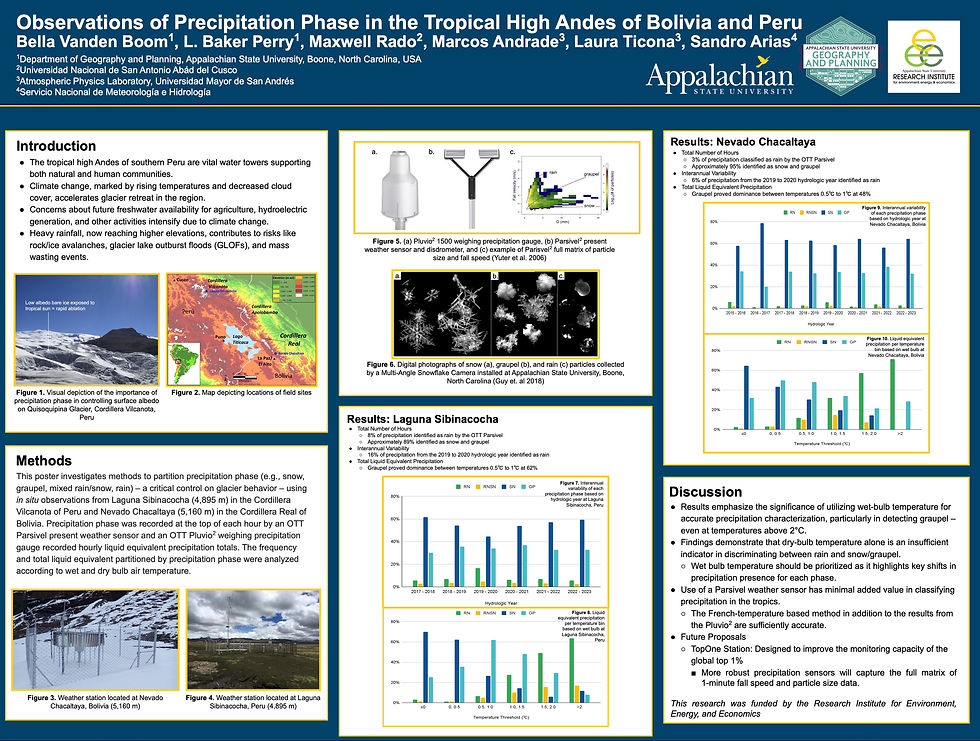
For the duration of my senior year, I was given the opportunity to work with Dr. Baker Perry as an undergraduate research assistant for a project we developed together, entitled, "Observations of Precipitation Phase in the Tropical High Andes of Bolivia and Peru." Utilizing precipitation data from two weather stations in Peru and Bolivia, I analyzed the best methods to partition precipitation phase for high elevation regions of the world. I presented my work in a poster format at the Celebration of Student Research and Creative Endeavors at Appalachian State in April 2024, and it was a great opportunity to share climate science work with faculty and students. I will be presenting again at the 80th Annual Eastern Snow Conference in Waterloo, Canada in June 2024, which will certainly be another great experience.


All photo credits to Michael Pettit Photography
Abstract & Poster
Author: Bella Vanden Boom
Co-Authors: L. Baker Perry, Maxwell Rado, Marcos Andrade, Sandro Arias, Laura Ticona
High-elevation glacierized cordilleras of the tropical Andes of southern Peru and Bolivia serve as significant water towers that sustain communities and ecosystems downstream. Recent climate change associated with increasing precipitation variability, rising freezing levels, and a higher percentage of precipitation falling as rain has accelerated glacier retreat across the region, exacerbating concerns about future freshwater availability for natural systems, agriculture, hydroelectric generation, and other human activities. This poster investigates methods to partition precipitation phase (e.g., snow, graupel, mixed rain/snow, rain) – a critical control on glacier behavior – using in situ observations from Laguna Sibinacocha (4,895 m) in the Cordillera Vilcanota of Peru and Nevado Chacaltaya (5,160 m) in the Cordillera Real of Bolivia. Precipitation phase was recorded at the top of each hour by an OTT Parsivel present weather sensor and an OTT Pluvio2 weighing precipitation gauge recorded hourly liquid equivalent precipitation totals. The frequency and total liquid equivalent partitioned by precipitation phase were analyzed according to wet and dry bulb air temperature. Initial results indicate that 8% of all precipitation at Laguna Sibinacocha was identified by the OTT Parsivel as rain, with approximately 89% of precipitation identified as snow and graupel. Succeeding results at Nevado Chacaltaya indicate that 3% of all precipitation was categorized by the OTT Parsivel as rain, with approximately 95% of precipitation categorized as snow and graupel. These findings will improve partitioning of precipitation phase by temperature-based methods at other tropical high mountain regions where observations of precipitation phase are not available.